By AAV Staff
In March 2026, Ghana led a United Nations resolution that called the transatlantic slave trade the “gravest crime against humanity,” demanded immediate reparations, and marked a major shift in how the world recognizes slavery’s lasting effects. The resolution passed with 123 votes, despite strong opposition from the United States, Israel, and Argentina. Still, modern slavery is a serious crisis in Africa, affecting millions. It is driven by both local and international criminal groups, and made worse by weak government responses.
To understand today’s push for reparations and recognition, it helps to look at the events that led to Ghana’s UN resolution, which was adopted on March 25, 2026.
- The resolution stated that the transatlantic slave trade and racialized chattel slavery are the gravest crimes against humanity.
- A total of 123 countries supported the resolution, while the United States, Israel, and Argentina voted against it. Fifty-two countries, including EU member states and the United Kingdom, abstained.
- The resolution’s goal is to support reparatory justice and help African nations heal from the lasting effects of slavery.
This recent milestone builds on a long history. The call for reparatory justice is rooted in the transatlantic slave trade, which lasted from the sixteenth to the nineteenth centuries.
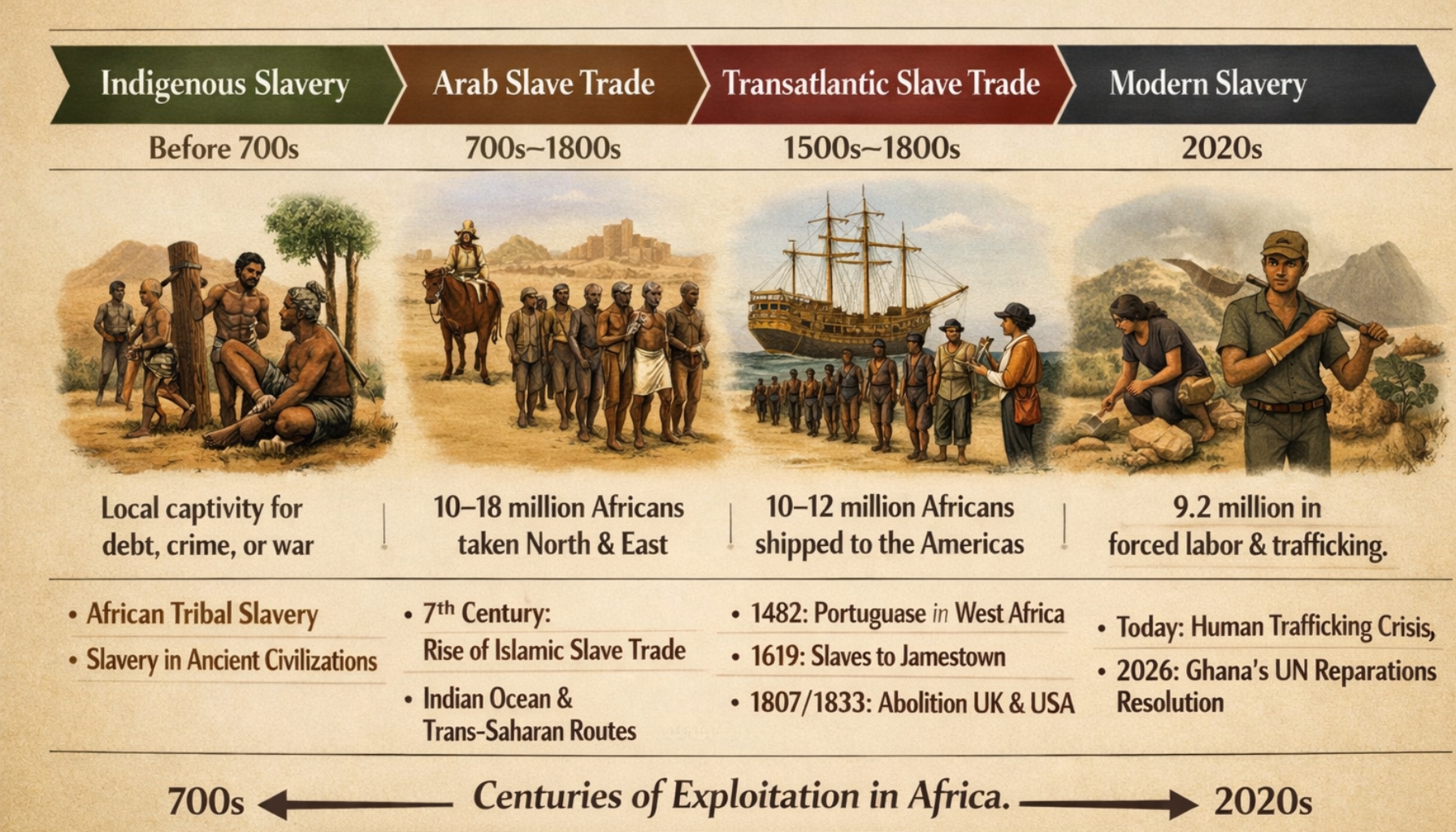
- It is estimated that 10 to 12 million Africans were forcibly taken across the Atlantic.
- West and Central Africa were the main regions affected.
- Africans were captured in raids or sold by local traders, held in coastal forts, and then transported across the Atlantic to the Americas.
- European demand for labor on sugar, cotton, and tobacco plantations fueled the slave trade. Portuguese and Spanish colonies started importing enslaved Africans as early as the late fifteenth century.
Today, modern slavery in Africa affects about 9.2 million people. This includes victims of forced labor, child exploitation, and human trafficking. The crisis is urgent and getting worse.
Victim distribution:
- In West Africa, there are high rates of child labor in fishing, farming, and domestic work, especially in countries like Ghana and Togo.
- In North Africa, migrant workers are often exploited in construction and domestic jobs.
- In East Africa, conflict zones like Sudan and Somalia see forced recruitment. In Southern Africa, exploitation happens in mining and informal work.
Africa has the highest share of global trafficking flows, with victims trafficked both within Africa and to other parts of the world.
Perpetrators of Modern Slavery
- African traffickers and organized crime groups exploit vulnerable people.
- Criminal networks from Europe, the Middle East, and Asia are also heavily involved in trafficking Africans to other countries.
- Victims are trafficked to Europe for sex work and labor, and to the Middle East for forced labor in various industries.
Government Responses
- Some African governments have made reforms and worked with international partners to fight slavery.
- However, many governments ignore or deny their responsibilities. This leads to more trafficking and lets criminals act without fear of punishment. Without strong action, these crimes will keep growing.
- According to the Global Slavery Index, several African countries are not protecting their citizens, putting millions at immediate risk.
Key Takeaway
Ghana’s UN resolution is an important step in recognizing the history of slavery, but urgent action is needed to end modern slavery in Africa. African governments should improve enforcement, hold offenders accountable, and work together both regionally and internationally. Real steps must be taken now to tackle the root causes, break up trafficking networks, and protect those at risk. Without working together, the human cost will keep rising.
Key Milestones Highlighted
| Period | Major Turning Points | Historical Notes |
|---|---|---|
| Indigenous Slavery (Before 700s) | African tribal slavery; slavery in ancient civilizations | Enslavement for debt, crime, or war; not hereditary |
| Arab Slave Trade (700s–1800s) | 7th century rise of Islamic slave trade; trans-Saharan and Indian Ocean routes | 10–18 million Africans taken north and east |
| Transatlantic Slave Trade (1500s–1800s) | 1482 Portuguese arrival in West Africa; 1619 first enslaved Africans in Jamestown; 1807/1833 abolition in UK & USA | 10–12 million Africans shipped to the Americas |
| Modern Slavery (2020s) | 2026 Ghana UN reparations resolution; ongoing trafficking crisis | 9.2 million Africans in forced labor and exploitation |
References