by and
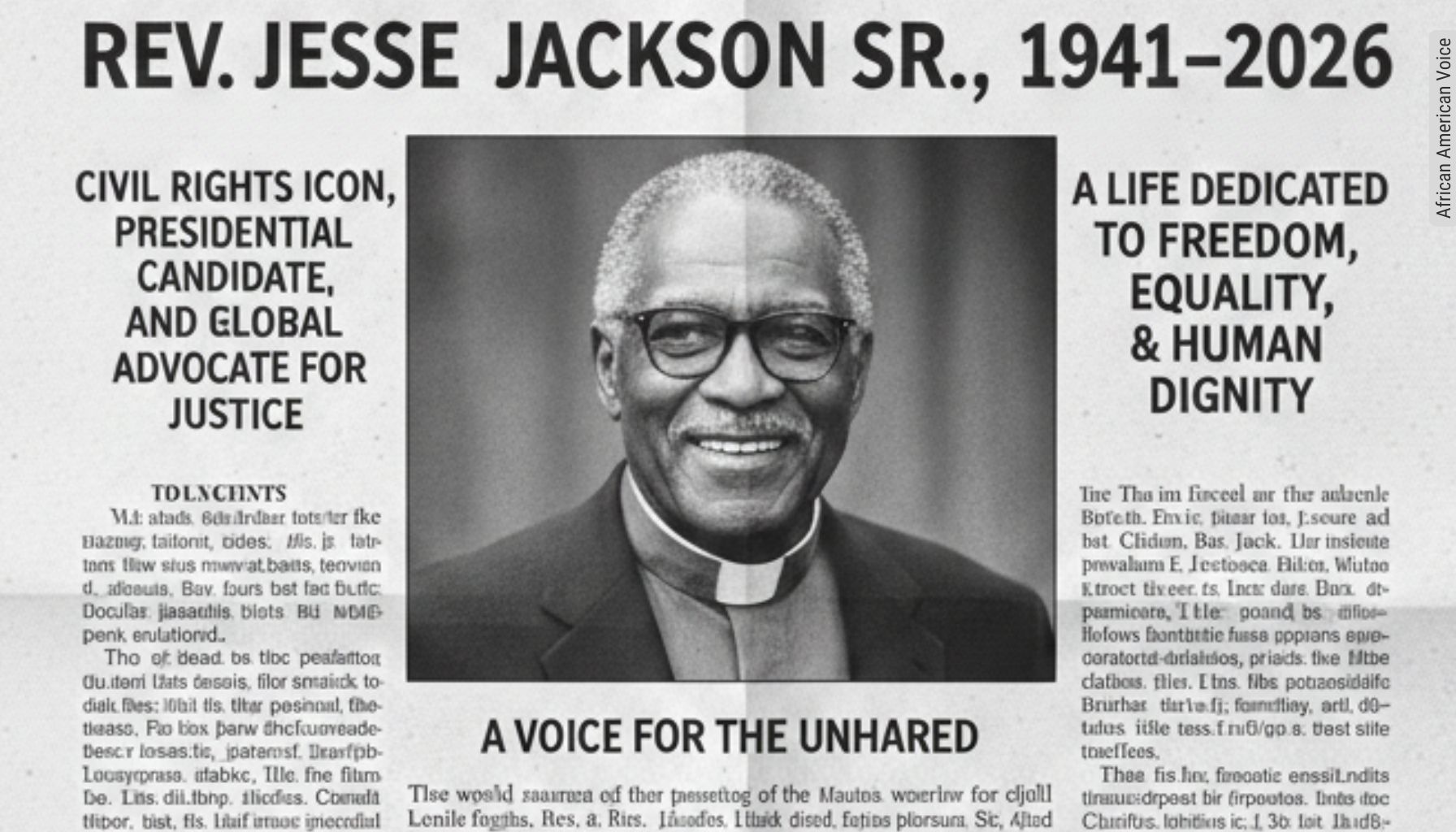
The Rev. Jesse L. Jackson, the son of segregated Greenville, South Carolina, who rose from the red clay of the Jim Crow South to become what admirers called the “Conscience of the Nation,” has died at 84.
While his death closes a chapter on more than half a century of agitation, negotiation, and unrelenting public witness on behalf of the poor, the marginalized, and the overlooked, family, faith leaders, politicians and activists are celebrating Jackson’s legacy and encouraging others to further his work.
“Our father was a servant leader — not only to our family, but to the oppressed, the voiceless, and the overlooked around the world,” the Jackson family said in a statement. “We shared him with the world, and in return, the world became part of our extended family. His unwavering belief in justice, equality, and love uplifted millions, and we ask you to honor his memory by continuing the fight for the values he lived by.”
Jackson’s life traced the arc of modern civil rights history. Born October 8, 1941, in Greenville, he would become founder and president of the Rainbow PUSH Coalition and one of America’s most recognizable civil rights, religious, and political figures. Over four decades, he played what his official biography describes as “a pivotal role in virtually every movement for empowerment, peace, civil rights, gender equality, and economic and social justice.”
“He has been the most famous person for the last 60 years,” the Rev. Grainger Browning to The Washington Informer. “The number of people impacted by his life has been incredible.”
A Torchbearer and Barrier-Breaking Politician
A protégé of the Rev. Dr. Martin Luther King Jr., Jackson was in Memphis on April 4, 1968, when King was assassinated. In the years that followed, he positioned himself as a torchbearer for the movement’s unfinished work, bringing the moral urgency of the Black church into boardrooms, political conventions, foreign capitals, and American streets.
As a young activist, Jackson immersed himself in sit-ins and voter registration drives. In 1965, he joined King’s Southern Christian Leadership Conference and was appointed to direct Operation Breadbasket, an effort aimed at leveraging Black buying power to force companies to hire and promote Black workers. By 1971, he had founded Operation PUSH in Chicago to expand economic and educational opportunities for disadvantaged communities.
In 1984, he launched the National Rainbow Coalition, later merging it with Operation PUSH to form the Rainbow PUSH Coalition. Through boycotts, shareholder activism, and public pressure, Jackson pushed corporations to diversify their workforces and invest in communities long shut out of opportunity.
“Citizens have the right to do something or do nothing,” Jackson said before traveling to Syria. “We choose to do something.”
His political ambitions broke barriers. Jackson ran for the Democratic presidential nomination in 1984 and again in 1988, registering millions of new voters and winning millions of votes. His campaigns expanded the boundaries of what was possible for Black candidates and laid groundwork for future generations.
“I was able to run for the presidency twice and redefine what was possible; it raised the lid for women and other people of color,” Jackson told The Associated Press. “Part of my job was to sow seeds of the possibilities.”
Despite not winning his presidential bid, his political work did not stop with his campaign. He served as the District’s first shadow senator from January 1991 to 1997, when he did not run for re-election.
“When he was the shadow Senator for the District it allowed him to work on the inside of politics and Civil Rights in addition to being an advocate for justice and his people,” Browning told The Informer.
Jackson’s Legacy
In 2000, President Bill Clinton awarded him the Presidential Medal of Freedom, the nation’s highest civilian honor.
“For more than five decades at the helm of the Rainbow PUSH Coalition, Rev. Jesse Jackson never faltered in the fight for justice, equality, and peace, always keeping hope alive,” Clinton wrote on X in July 2023 when Jackson stepped down as president of Rainbow PUSH Coalition. “I’m grateful to my friend for his many miles marched and inspiring so many to follow in his footsteps.”
Jackson’s voice — rhythmic, insistent, and shaped by the traditions of the Black church — carried slogans that became part of the nation’s political lexicon. “Keep Hope Alive” echoed through campaign rallies and community meetings alike. His “I Am Somebody” refrain affirmed dignity in the face of poverty and discrimination.
He faced criticism and controversy during his public life, yet when Barack Obama won the presidency, Jackson stood in Chicago’s Grant Park, overcome with emotion.
Even as illness overtook him in later years, Jackson continued to appear at protests and public events. During the COVID-19 pandemic, after he and his wife were hospitalized, he urged vaccination, particularly in Black communities.
“It’s America’s unfinished business — we’re free, but not equal,” Jackson told the AP. “There’s a reality check that has been brought by the coronavirus, that exposes the weakness and the opportunity.”
Source: Published without changes from Washington Informer Newspaper